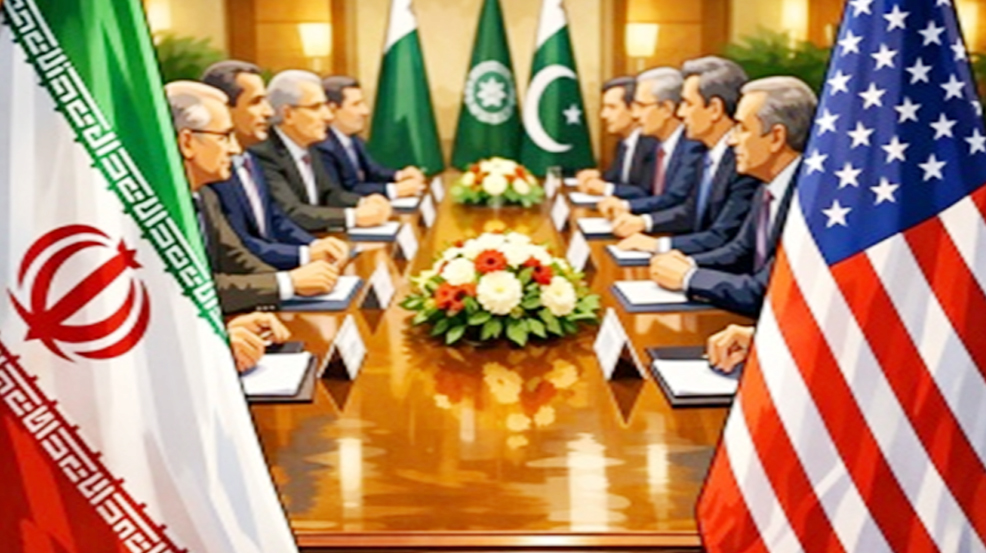
Moon Desk: Pakistan has set the stage for a high-stakes second round of negotiations between the United States and Iran in Islamabad, likely to take place just hours before a Pakistan-brokered ceasefire expires on Wednesday. Despite lingering uncertainty surrounding ‘Islamabad Round 2’ due to Iran’s reluctance to formally confirm its participation, a US delegation led by Vice President JD Vance is set to travel to the federal capital along with senior officials. There was some ambiguity about Vance’s whereabouts, as President Donald Trump told the New York Post that Vance was already on his way to Islamabad, but White House officials said the vice president would depart on Tuesday, with talks expected on Wednesday.
While there was confusion over the exact timing of arrival, there was certainty that the US delegation would be coming. Iran, however, has maintained public suspense, even though developments on the ground in Islamabad suggest a different trajectory. Even hours after the Iranian Foreign Ministry spokesperson said Tehran had not yet decided whether to join the talks, US military aircraft were seen landing at Nur Khan Airbase, indicating that preparations were moving ahead regardless of the public posture.
Iran has accused the United States of not adhering to the ceasefire terms and has urged Washington to end its naval blockade of the strategic Strait of Hormuz before entering negotiations. “Honouring commitments is the basis of meaningful dialogue. Deep historical mistrust in Iran toward U.S. government conduct remains, while unconstructive and contradictory signals from American officials carry a bitter message: they seek Iran’s surrender. Iranians do not submit to force,” Iranian President Dr Masoud Pezeshkian wrote on X.
Pakistani officials remained tight-lipped but privately acknowledged that much of the uncertainty stemmed from pre-talk “posturing” by both sides. Diplomatic sources said backchannel contacts between Washington and Tehran remained active. According to a British news agency report, Field Marshal Asim Munir established contact with President Trump. During the conversation, the report said, he emphasised that the blockade of the Strait of Hormuz was impeding diplomatic progress.
Officials indicated that preparations for the talks have entered their final phase, with American advance teams continuing to arrive ahead of formal negotiations. Between Sunday and late Monday night, 11 aircraft carrying personnel, vehicles and operational equipment had landed.
Sources said the arrival of advance teams has largely been completed, while the main delegations are expected to arrive by Tuesday. They added that Iranian delegations may also reach Islamabad by Tuesday night. The sources noted that arrangements for Round 2 closely mirror those made during the previous phase, adding that security across the twin cities has been significantly tightened, with more than 18,000 personnel from the federal police and other agencies deployed. The urgency for talks is heightened by the impending expiration of a two-week ceasefire between the US and Iran, brokered by Pakistan on April 7. The truce is set to lapse Tuesday evening, Washington time, corresponding to Wednesday morning in Iran.
President Trump has offered mixed signals on whether the ceasefire will be extended. At one point, he warned that “if there’s no deal, fighting resumes,” while in other remarks he suggested an extension remained possible if required.