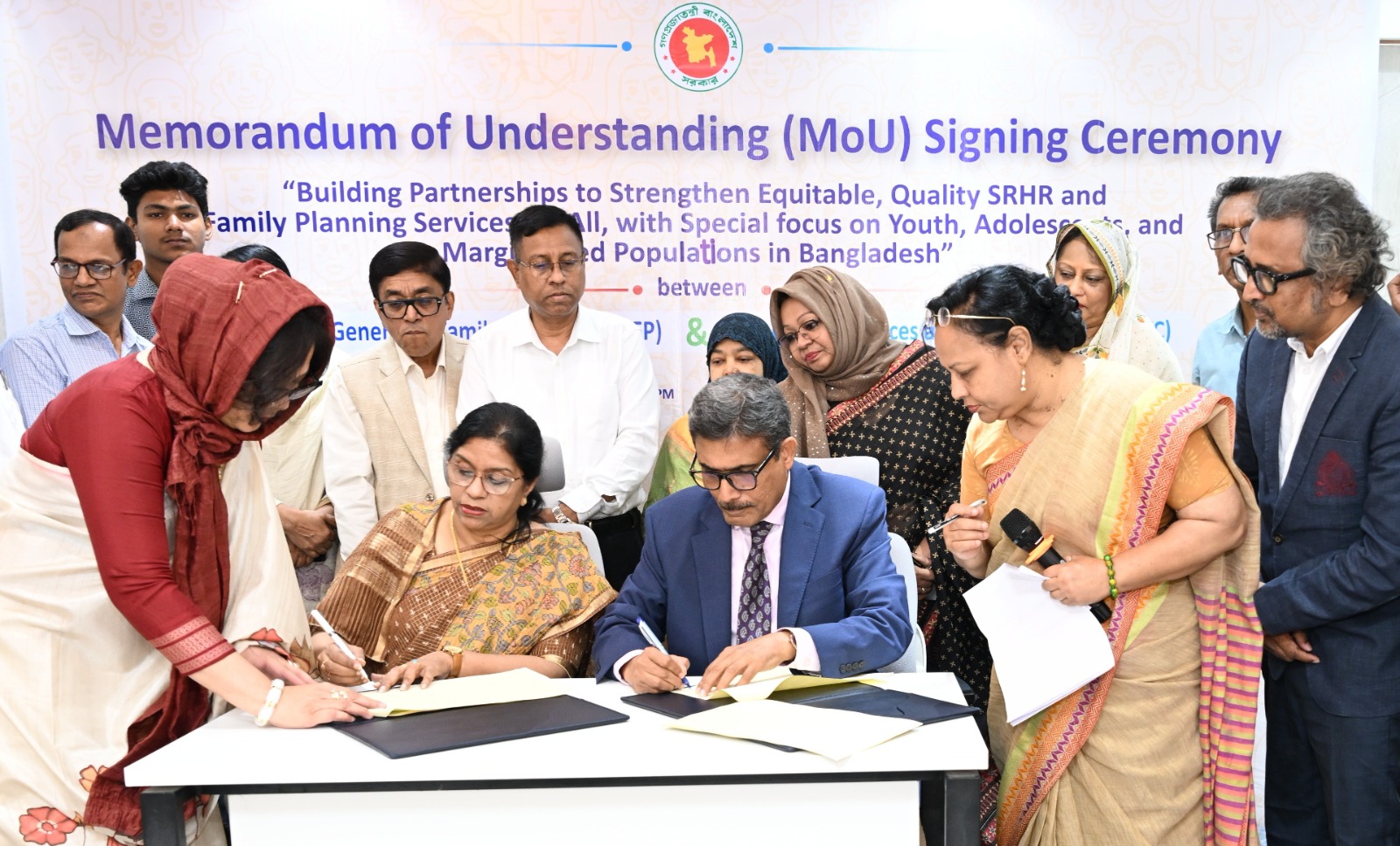
Desk Report: The Directorate General of Family Planning (DGFP) and Population Services and Training Center (PSTC) signed a Memorandum of Understanding on Tuesday, May 19, 2026, to strengthen collaboration on sexual and reproductive health and rights (SRHR) and family planning services across Bangladesh.
The agreement focuses on delivering equitable, high-quality services with special emphasis on youth, adolescents, and marginalized populations. The signing ceremony took place at the PSTC Multipurpose Hall in Dhaka.
Senior officials present included Dr. Ashrafee Ahmad, NDC, DG (Grade-1), DGFP; Ms. Sabina Pervin, Director of Planning & Coordination; Mr. Taslim Uddin Khan, Director of IEM; and Dr. Nasir Ahmed, Director of MCH (Services). Development partners, health experts, civil society representatives, and youth advocates also attended.
Under the MoU, DGFP and PSTC will jointly implement initiatives covering Comprehensive Sexuality Education (CSE), adolescent health, emergency SRHR response, faith-based engagement, advocacy, policy dialogue, and evidence-based program monitoring.
DGFP officials reaffirmed the government’s commitment to strengthening adolescent-friendly health services, social and behavior change communication (SBCC), and multi-sectoral coordination to meet national health and development goals. PSTC representatives pledged technical assistance, community engagement, capacity building, youth leadership development, and evidence generation, noting continued support from the International Planned Parenthood Federation (IPPF).
The partnership will initially target five districts: Dhaka, Gazipur, Narsingdi, Mymensingh, Kushtia, and Faridpur, with scope for expansion based on national priorities.
Key expected outcomes include increased SRHR and family planning awareness, improved access to youth-friendly services, reduced stigma and harmful social norms, stronger emergency preparedness and MISP implementation during crises, and better coordination and evidence-based decision-making.
PSTC, established in 1978, is a national NGO working to improve health, social security, and living conditions for disadvantaged populations. It operates in 21 districts with 23 service delivery points and reaches over one million people annually with SRHR services.
The ceremony concluded with the formal signing, exchange of crests and documents, and a joint commitment to advance a healthier, more equitable, and rights-based future for Bangladesh.