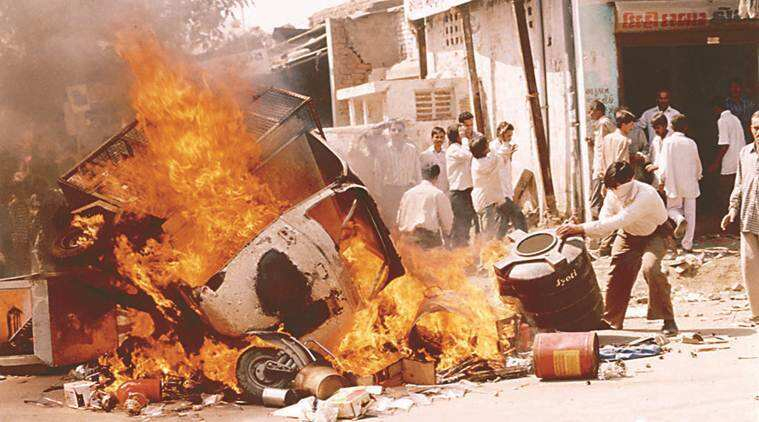
Moon Desk: The Gujarat High Court has upheld the acquittal of five Hindutva men accused of throwing a Muslim man alive into a fire during the 2002 Muslim genocide, observing that the prosecution failed to establish their involvement beyond reasonable doubt. A division bench comprising Justices Nirzar S. Desai and D.N. Ray noted that key witnesses were unable to identify the accused as members of the mob that allegedly committed the offence.
The prosecution had alleged that the accused were part of an unlawful assembly that attacked the home and shop of the deceased, Samsuddin alias Kasamkhan, looted property, set it on fire, and allegedly threw him into the flames, causing his death. The State had challenged a 2003 sessions court order acquitting the accused of charges including rioting, unlawful assembly, arson, murder, and abetment under the IPC. It argued that the trial court erred in disregarding eyewitness testimony and drawing adverse inferences from the absence of identifiable remains.
However, the High Court dismissed the appeal, affirming that the prosecution had failed to prove the charges beyond reasonable doubt. On 28 February 2002, Hindu mobs who were part of the Vishva Hindu Parishad (VHP), Rashtriya Swayamsevak Sangh (RSS), and Bharatiya Janata Party (BJP), unleashed massive violence against Muslims in Gujarat that went on for weeks, killing thousands of Muslims, following the train burning incident near Godhra railway station in February 2002.
In this case, a mob of around 200 people gathered near Khodiarnagar in Vadodara. On the night of February 28, the group engaged in rioting, entered the house of Samsuddin alias Kasamkhan, removed household articles and goods from his and his brother’s shop, and set them on fire. Amid the violence, the deceased was apprehended, assaulted, and thrown into the fire, resulting in his death.
The incident also led to extensive damage to property belonging to the deceased and his family. About 3,000 Muslims were killed in what has been described as a Muslim genocide, while nearly 20,000 homes and businesses, 360 places of worship, were destroyed, and around 150,000 people were displaced.
Narendra Modi, the current prime minister of India, was accused of initiating and condoning the violence by allegedly instructing the police to stand down and allow Hindu mobs to carry out attacks against Muslims. Reports suggest strong links between the Modi-led Gujarat administration and the coordinated nature of the anti-Muslim violence.
Hindu mobs were reported to have detailed lists of Muslim homes and businesses, and many of the attacks happened in close proximity to police stations. Following this, hundreds of Hindus, including leaders of various Hindutva groups, were charged, but Gujarat’s courts have acquitted many of them over time, with several earlier convictions also being overturned.
In May 2018, the Gujarat High Court acquitted three persons convicted in the Ode massacre in Anand, upheld the acquittal of 23 others, and maintained the conviction of 19. Earlier, in 2023, a special court in Ahmedabad hearing cases related to the 2002 violence acquitted all 67 accused in the Naroda Gam massacre case, including BJP leaders Maya Kodnani, Babu Bajrangi, and Jaydeep Patel.